When you research RO systems or water purifiers, you have likely often come across the term MTDS in Water Purifier. However, for many people, it remains unclear what MTDS actually stands for and how it functions.
Simply put, MTDS is a technology designed to help balance the TDS level of your water. In other words, it ensures that the water you receive is neither overloaded with dissolved particles nor completely devoid of taste.
For this very reason, most modern water purifiers today feature an MTDS function, ensuring that you enjoy superior drinking water quality.
Full Form and Meaning of MTDS
The full form of MTDS is Manual Total Dissolved Solids Controller. It is a small yet critical component, typically installed within RO water purifier systems.
Now, you might be wondering: what exactly does it do?
- MTDS works by blending purified water with raw (untreated) water.
- This process keeps the water’s TDS level under control.
- It allows you to adjust the taste and quality of the water according to your specific preferences.
When an RO system purifies water, it removes the majority of dissolved substances. Consequently, the water can become very light (characterized by low TDS levels). In such instances, MTDS helps restore a balanced mineral content by blending in a small amount of untreated water.
This is why many people also refer to MTDS simply as a TDS controller in water purifiers.
If you desire better taste and truly clean drinking water, the role of MTDS becomes absolutely vital.
Why Modern RO Systems Use MTDS Technology
In today’s world, merely purifying water is no longer sufficient; it is equally essential to maintain its taste and quality. This is precisely why the use of MTDS technology is becoming increasingly prevalent in modern RO systems.
There are several key reasons behind this:
- An RO system removes almost all dissolved solids from the water.
- When the TDS level is very low, the water may taste bland.
- MTDS technology maintains a controlled mineral balance in the water.
Furthermore:
- It offers you a customized water taste.
- The TDS level can be adjusted to suit the specific water quality of different regions.
- It makes drinking water taste more natural and palatable.
If the water in your area already contains a high concentration of dissolved particles, the RO system reduces them. Conversely, if the level drops too low, the MTDS system restores the balance. In this way, you are ensured balanced drinking water at all times.
That is why, nowadays, when purchasing a new water purifier, people specifically look for the MTDS feature, as it directly impacts the taste and overall quality of your water.
Important Takeaways:
- MTDS stands for Manual Total Dissolved Solids Controller.
- It helps in balancing the TDS level of the water.
- When combined with an RO purifier, it delivers superior drinking water quality.
- It improves the taste of the water by raising levels that have dropped too low.
- MTDS technology has become an essential feature in modern water purifiers.
Why MTDS is Used in RO Water Purifiers
When you use an RO water purifier, it cleans the water very thoroughly. However, this purification process is sometimes so intense that the essential minerals present in the water are almost completely eliminated. In such cases, both the taste and the quality of the water can be compromised.
This is precisely where MTDS in Water Purifier comes into play. It is a feature designed to help maintain a balance in the water purified by the RO system, ensuring that you receive not just clean water, but also potable and great-tasting drinking water.
Maintaining a Balanced Mineral Level in Water
An RO system removes most of the dissolved solids from the water, which can result in a significantly low TDS (Total Dissolved Solids) level. However, the complete removal of minerals is not ideal either.
This is why MTDS is utilized—to ensure that:
- A balance of essential minerals is maintained in the water.
- The water does not become excessively light (due to very low TDS).
- The overall quality of the drinking water remains high.
MTDS blends a small amount of raw water with the purified water, thereby reintroducing a certain quantity of natural minerals into the mix. This provides you with balanced water suitable for daily consumption.
Improving the Taste of Purified Drinking Water
If you have ever consumed RO-purified water with a very low TDS level, you may have found it to taste somewhat bland or “flat.” This occurs because the mineral content in such water is extremely low.
MTDS helps resolve this issue by:
- Retaining a certain level of mineral content in the water.
- Making the water taste natural and fresh.
- Enhancing your overall drinking experience on a daily basis.
For this very reason, people often prefer purifiers equipped with MTDS to improve the taste of their water.
Preventing Water From Becoming Too Pure
Many people believe that the purer the water, the better it is. However, the reality is that over-purified water—water that is excessively pure—is not always beneficial.
When nearly all dissolved solids in water are eliminated:
- The water acquires a very bland taste.
- It fails to provide a sense of satisfaction when consumed.
- Certain essential natural elements are also depleted.
MTDS restores balance to this situation:
- It prevents the water from being over-purified.
- It maintains the TDS level in a controlled manner.
- It provides you with balanced drinking water for daily use.
For this reason, MTDS technology is considered a crucial feature in modern RO systems today.
Make an Informed Choice:
- MTDS helps maintain the right balance of minerals in the water.
- It enhances the taste of RO-purified water.
- It balances water that has undergone excessive purification.
- MTDS is an essential feature for ensuring superior drinking water quality.
- If you are purchasing a new water purifier, be sure to look for the MTDS feature in it.
How does MTDS work in an RO water purifier?
When you use an RO water purifier, it cleans the water very thoroughly. However—as you may have understood earlier—RO systems sometimes over-purify the water, causing its TDS level to drop significantly.
This is precisely where MTDS in water purifier comes into play. This technology employs a specific process to balance the water’s TDS level, ensuring that you have access to clean and balanced water for your daily consumption.
Let’s now understand how this system functions internally.
Mixing Purified Water With a Controlled Amount of Raw Water
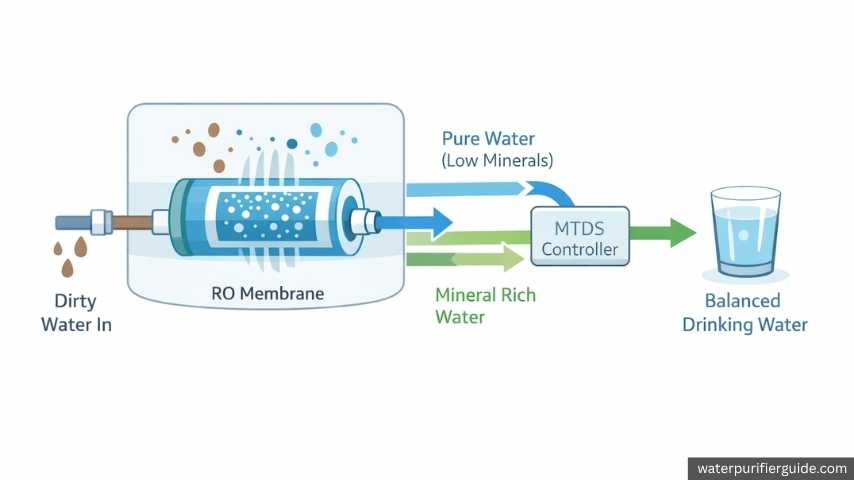
The primary function of MTDS is to mix a controlled amount of raw water into the purified water.
When the RO membrane purifies the water:
- It removes the majority of dissolved solids.
- Consequently, the water’s TDS level drops significantly.
Subsequently, the MTDS system:
- Mixes back a small quantity of untreated (raw) water.
- This mixing is executed in a completely controlled manner.
- As a result, the final TDS level of the water becomes balanced.
Thanks to this process, certain essential minerals are retained in the water, resulting in a better taste for your drinking water.
Role of the MTDS Control Valve in the System
The MTDS system features a small yet crucial component: MTDS control valve.
This valve governs the entire mixing process:
- It determines the precise ratio of purified water to raw water that will be mixed.
- You can also adjust it manually.
- This allows you to control the TDS level of your water.
For instance:
- If the water tastes too bland, you can adjust the valve to slightly increase the TDS level.
- If the water feels like it contains an excessive amount of dissolved particles, the TDS level can be lowered.
In this way, the MTDS control valve empowers you to achieve customized water quality.
Simple Step-by-Step Working Process
Now, let’s understand the entire working mechanism of the MTDS system in simple steps:
- First, the water passes through the RO membrane.
- The RO process removes the majority of dissolved solids from the water.
- Subsequently, a portion of this water emerges as purified water.
- The MTDS system draws in a small amount of raw water through a separate line.
- The MTDS control valve mixes the two streams of water in a controlled ratio.
- Finally, you receive drinking water with a balanced TDS level.
Throughout this entire process, the MTDS system ensures that the water is neither excessively pure nor too heavy (high TDS).
For this very reason, people nowadays prefer RO purifiers equipped with MTDS, as they provide water that is not only clean but also tasty and balanced.
What You Should Do Next:
- The MTDS system balances the TDS level by blending purified water with raw water.
- The MTDS control valve regulates this mixing process.
- This results in drinking water with a superior taste and balanced composition.
- If the taste of the water changes, it is essential to check the MTDS settings.
- To ensure optimal performance, do not forget to check the TDS level periodically.
Key Benefits of MTDS in Water Purification
When you use an RO water purifier, simply having clean water isn’t enough. You want the water to taste good, retain essential minerals, and offer an overall improvement in drinking water quality.
This is where MTDS in Water Purifier becomes a crucial feature for you. It not only balances the water but also provides you with cleaner, higher-quality water for your daily use.
Let’s now explore its key benefits:
Better Taste of Drinking Water
RO water purifiers often purify water so thoroughly that it begins to taste bland or “flat.” This occurs because the mineral content in the water becomes extremely low.
MTDS resolves this issue:
- It maintains a slight mineral balance within the water.
- This makes the water taste natural and fresh.
- It provides a more satisfying drinking experience for your daily consumption.
If you have ever consumed water with very low TDS levels, you can easily perceive the difference. With MTDS, the water tastes much more like pleasant, natural drinking water.
Balanced Mineral Content
Certain minerals present in water are essential for your health. However, during the RO purification process, a significant portion of these minerals is removed.
MTDS compensates for this deficiency:
- It blends a controlled amount of raw water back into the purified water.
- This ensures that the water retains a balanced mineral content.
- The water ends up neither too “light” nor too “heavy.”
The benefit of this is that you receive safe and balanced water for your daily needs.
If you consume water with extremely low TDS levels over a prolonged period, both the taste and the overall experience can be unsatisfactory. Therefore, maintaining a balanced TDS level is essential.
Greater Control Over Water Quality
A major advantage of MTDS is that it grants you greater control over the quality of your water. You can adjust the TDS level using the MTDS valve.
- You can make adjustments based on your specific needs and the water source.
- You can modify the settings to adapt to changing seasons or variations in the water supply.
This means that you are not solely dependent on the machine; rather, you can actively manage your water quality yourself.
If you periodically check the TDS level and adjust the MTDS valve, you will consistently enjoy superior clean drinking water.
Final Thoughts to Consider:
- MTDS enhances the taste of the water, making it more natural.
- It maintains the proper balance of minerals in the water.
- It gives you greater control over water quality.
- MTDS in water purifier is an essential feature for an optimal user experience.
- Periodic checks and adjustments are beneficial for maintaining the correct TDS level.
Common Issues Related to MTDS in RO Water Purifier
When you use an RO system equipped with an MTDS feature, it typically helps maintain the proper balance of the water. However, common issues may occasionally arise that can alter the water’s taste or quality.
If you identify these issues in a timely manner, you can easily restore the quality of your drinking water.
Let’s examine these common problems one by one:
Water Taste Changes Suddenly
If you suddenly notice a change in the taste of your water, it could be an indication that there is a malfunction within the MTDS system.
You might perceive this change in the following ways:
- The water begins to taste flat—more so than before.
- It develops a slightly salty or bitter aftertaste.
- It lacks the usual balance you are accustomed to in your daily drinking water.
Why does this happen?
- The MTDS mixing process is not occurring correctly.
- The TDS level has shifted abruptly.
- The purifier’s filters or membrane have become worn out or compromised.
In such a situation, you should immediately check the TDS level of the water. This will help you identify the root cause of the problem.
TDS Level Becomes Too High or Too Low
The primary function of the MTDS is to keep the TDS levels balanced. However, if there is an issue with its settings or the system itself, the TDS levels may become either excessively high or too low.
Very Low TDS:
- The water tastes very light and flat.
- It lacks freshness in its flavor.
Very High TDS:
- The water may taste salty or feel “heavy.”
- The overall drinking experience can be unpleasant.
The underlying causes for this could be:
- The MTDS valve is not adjusted correctly.
- The RO membrane is not functioning properly.
- The proportion of raw (untreated) water being mixed in has increased or decreased.
Therefore, it is crucial to perform a water TDS test periodically so that you can detect any issues at the earliest stage.
When the MTDS Setting Needs Adjustment
Often, the problem is not a major malfunction; it simply requires an adjustment to the MTDS settings. However, it is crucial to recognize when an adjustment is necessary.
You may need to modify the MTDS settings in the following situations:
- When the taste of the water changes from its usual quality
- When the TDS reading fluctuates suddenly
- When the water feels different after the purifier has undergone servicing
- When the water source (such as a borewell or tank) changes
In such cases, you should:
- Adjust the MTDS control valve slightly
- Check the TDS Level again after making the adjustment
- Seek assistance from a technician if required
Keep in mind that frequently altering the settings without proper understanding is not advisable. Always make adjustments with the goal of maintaining balanced drinking water in mind.
Don’t Overlook This:
- A sudden change in the taste of the water could be an indication of an MTDS-related issue.
- Neither excessively high nor excessively low TDS levels are considered ideal.
- The MTDS settings may require periodic adjustments.
- Regularly checking the TDS level is essential for accurate monitoring.
- Do not ignore minor issues, as they can adversely affect the quality of your water.
How to Adjust MTDS in Water Purifier
If you have an RO water purifier installed in your home and it features the MTDS (Manual TDS) control, you can adjust the water’s TDS level according to your specific needs.
This is a useful feature that allows you to enhance both the taste of the water and the overall drinking water quality.
However, it is crucial to adjust the MTDS settings correctly. Making changes without the proper knowledge can result in water that tastes either too bland or too “heavy” (due to high TDS levels). Therefore, you should proceed with this task only after understanding the correct procedure.
Measuring Water TDS Using a Digital Meter
The most essential step before adjusting the MTDS settings is measuring the water’s current TDS level. For this, you can use a Digital TDS Meter.
This is a simple and quick method:
- Pour some water into a clean glass.
- Immerse the TDS meter into the water.
- Within a few seconds, the TDS reading (in ppm) will appear on the screen.
- This reading indicates the concentration of dissolved substances present in the water.
If you wish to make accurate adjustments, ensure you check the water’s TDS level both before and after making changes. This will help you determine whether the adjustments are moving in the right direction.
This method provides you with accurate data, enabling you to exercise better water quality control.
The Safe Way to Adjust the MTDS Control
Now that you know the water’s current TDS level, you can proceed to adjust the MTDS control. However, it is essential to perform this task with caution.
Here is how you can make safe adjustments:
- Adjust the MTDS control valve gradually.
- Avoid making drastic changes all at once.
- Check the TDS level again after every adjustment.
- Carefully assess the taste of the water as well.
Keep a few important points in mind:
- If the water tastes very bland, you may need to slightly increase the TDS level.
- If the water tastes heavy or salty, reduce the TDS level.
- Make small, incremental adjustments until the reading falls within the ideal range.
If you are unsure about how much to adjust the settings, it is best to seek assistance from an expert technician. This helps you avoid accidentally applying incorrect settings.
By properly adjusting the MTDS, you will consistently obtain balanced and clean drinking water—superior in both taste and quality.
What You Should Do Next:
- Always measure the TDS level before adjusting the MTDS.
- A digital TDS meter helps ensure accurate readings.
- Adjust the MTDS valve slowly and carefully.
- Be sure to check the water’s TDS level and taste after every adjustment.
- For optimal results, continue to check the TDS level periodically.
Do All RO Water Purifiers Have MTDS Technology?
When you consider purchasing a new RO purifier, the question may cross your mind: does every system feature MTDS technology?
The straightforward answer is—no, not all RO water purifiers are equipped with MTDS technology. It is an additional feature that proves particularly useful under specific circumstances.
Essentially, MTDS is utilized when there is a need to balance the Total Dissolved Solids (TDS) levels in the water. However, water conditions vary from household to household; consequently, this feature is not a necessity in every situation.
Let’s explore this in a little more detail.
Situations Where MTDS Is Useful
While MTDS is not universally required, it becomes an extremely valuable feature in certain specific situations.
MTDS could be beneficial for you if:
- The water in your home becomes excessively pure (low TDS) after passing through the RO system.
- The water begins to taste bland or “flat.”
- You wish to maintain a certain natural mineral balance within the water.
- The TDS levels of the water in your locality tend to fluctuate over time.
In such scenarios, MTDS:
- Restores the mineral balance in the water in a controlled manner.
- Enhances the taste of the drinking water.
- Provides you with balanced drinking water suitable for daily consumption.
For this reason, in households where the RO system renders the water excessively pure, an RO system equipped with MTDS is considered a superior choice.
Types of Purifiers That May Not Require It
Now, the question arises: in which cases is MTDS not required? There are certain water purifiers where an MTDS feature is not required, such as:
- UV (Ultraviolet) purifiers
- UF (Ultrafiltration) purifiers
- RO systems where the TDS level is already balanced
In these purifiers:
- The water’s TDS level is not significantly reduced.
- The primary focus is on removing bacteria and impurities.
- Consequently, there is minimal alteration to the mineral balance.
If the water supply in your home already falls within a balanced TDS range, you may not necessarily need the MTDS feature.
Furthermore, some individuals prefer a simple purification process and do not require any significant alteration to the taste of the water—in such cases, the MTDS feature is not essential either.
However, if your goal is to achieve the highest drinking water quality and superior taste, a purifier equipped with the MTDS feature would be a more suitable choice.
Before You Decide:
- Not all RO purifiers come equipped with the MTDS feature.
- The MTDS feature is particularly useful when the water’s TDS level drops too low.
- It helps enhance both the taste of the water and its mineral balance.
- It is not required in certain types of purifiers (such as UV or UF).
- When purchasing a purifier, assess the specific condition of your water supply before deciding whether to opt for a model featuring MTDS.
FAQs Section:
If you are considering purchasing a new water purifier or are already using an RO system, you may have several questions regarding MTDS in water purifiers. This is perfectly normal, as MTDS directly impacts the quality and taste of your drinking water.
Below, you will find simple and clear answers to some of the most common questions to help you make an informed decision.
1. Is MTDS necessary for home water purifiers?
MTDS is not essential for every household, but in many situations, it proves to be highly beneficial.
MTDS may be necessary for you if:
- The water becomes very bland (low TDS) after passing through the RO system.
- You find the taste of the water unappealing.
- You desire balanced mineral water.
However, if the water in your area is already balanced and the purifier does not significantly reduce the TDS levels, the need for MTDS may be minimal. Therefore, it depends entirely on your specific water source and usage patterns.
2. Does MTDS add minerals to purified water?
This is a common misconception. MTDS does not “add” minerals in the conventional sense; instead, it employs a smart mechanism:
- It blends a small amount of raw water into the purified water.
- This raw water already contains naturally occurring minerals.
- As a result, the water’s TDS level becomes balanced.
In essence, MTDS does not introduce new minerals; rather, it reintroduces existing minerals in a controlled manner.
3. What is the ideal TDS level for drinking water?
Knowing the appropriate TDS level for drinking water is crucial, as it determines both the taste and utility of the water.
Generally:
- 80–150 ppm: Considered the most optimal and balanced range.
- 150–300 ppm: Still acceptable, though the taste may vary slightly.
- Below 50 ppm: The water may taste very bland or flat.
By regularly checking the TDS level of your drinking water, you can easily determine whether your water falls within this ideal range.
4. Can MTDS settings be changed at home?
Yes, in many RO systems, the MTDS setting can be adjusted manually; however, this requires a certain degree of caution.
You can:
- Slightly adjust the MTDS control valve.
- Perform a water TDS test again after making the adjustment.
- Fine-tune the setting based on the taste and the TDS reading.
However, keep the following in mind:
- Frequently changing the settings without proper understanding is not advisable.
- If you lack the necessary knowledge, it is better to seek the assistance of a technician.
With proper adjustment, you can ensure a consistent supply of balanced and clean drinking water in your home.