When you use water for drinking every day, it is not enough to just see whether the water looks clean or not. Sometimes water appears clear, but dissolved substances may be present inside it. Therefore, it is very important to check the TDS level of water from time to time.
TDS stands for Total Dissolved Solids, i.e. minerals, salt, and other small particles dissolved in water. If you Check TDS Level from time to time, it helps you to understand whether your water is safe to drink or not.
Apart from this, by knowing the TDS level you can also decide whether your water purifier is working properly or not. If TDS becomes too high, both the taste and quality of water can be affected.
How TDS Affects Water Taste
TDS level has a direct impact on the taste of water. When the amount of minerals dissolved in water changes, the taste of water also changes.
For example:
- If TDS is too low, water may appear dull or flat.
- If TDS is too high, water may taste salty or bitter.
- When minerals are in the right balance, water tastes fresh and good.
This is the reason why many people like to check the TDS of water in their house with TDS meter. With this you can immediately understand whether your drinking water is safe or not.
If you regularly Check TDS Level of water, you can also know whether there has been a sudden change in the water in your house.
Impact of Dissolved Minerals on Water Quality
Dissolved minerals present in water affect not only the taste but also the overall quality of water. Some minerals are beneficial for the body, but it is not considered right to have too much or too little of their quantity.
These substances are commonly found in water:
- Calcium
- Magnesium
- Sodium
- Iron
- Small salt and mineral particles
These minerals in balanced quantity give natural taste to water. But if their quantity increases too much, then:
- Water may taste bad
- Stains or deposits may form on utensils and pipes
- There may be discomfort in drinking water
This is the reason why people in many homes check water TDS level from time to time, so that they can get an accurate idea of the quality of their drinking water.
If you use a water purifier in your home, then checking the TDS level becomes even more important. With this you can understand whether your purifier is working properly in providing clean water or not.
Important Points to Remember
- TDS Level gives you information about the substances dissolved in water.
- Water tastes better when it has correct TDS.
- Too much or too little TDS can affect the quality of water.
- By Check TDS Level from time to time, you can understand the condition of your drinking water.
- If you use a water purifier, checking TDS also helps in understanding its efficiency.
Different Ways to Measure TDS in Water at Home
If you want to know whether the water in your house is safe for drinking or not, then first of all you should know the TDS level of water. TDS means Total Dissolved Solids, which shows the amount of minerals and small particles dissolved in water.
The good thing is that in today’s time it is very easy to Measure TDS in Water. You can find out TDS of water at home with some easy methods. This helps you understand how your drinking water quality is and whether your water purifier is working properly.
Below are some common ways you can measure the TDS level of water at home.
Using a Digital TDS Meter
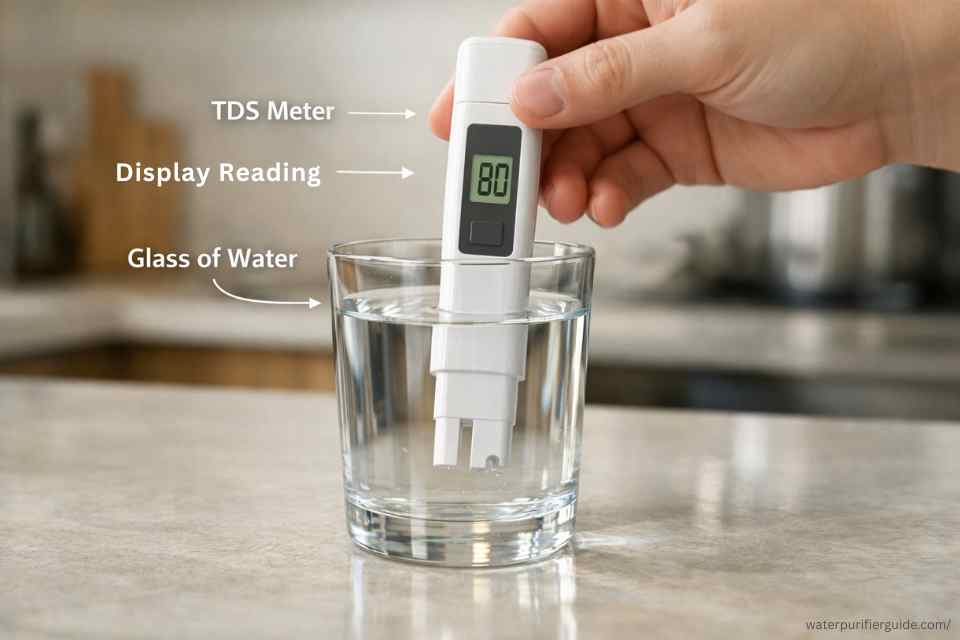
The easiest and popular way to measure TDS in water at home is to use Digital TDS Meter. It is a small electronic device which shows you the TDS reading of water in a few seconds.
You can use it very easily:
- First of all take water in a clean glass.
- Now dip the TDS meter in water for a few seconds.
- TDS reading will start appearing on the screen within some time.
- This reading tells how much substance is dissolved in water.
With this method you can quickly and easily Measure TDS in Water at home. This is why many people use a TDS meter to do water TDS test in their home regularly.
Testing Water Through a Laboratory
If you want more accurate information about water quality, you can also get your water tested at a water testing laboratory.
This process usually requires you to:
- A sample of water has to be given
- That water is thoroughly tested in the lab
- In the report you get information about TDS level and other substances
With the help of lab test, you get to know not only about TDS but also about the overall water quality of the water. However, this method may take a little time and expense compared to checking with a TDS meter at home.
However, if you want complete information about the condition of your water, then laboratory water test can be a good option.
Other Basic Methods to Estimate Dissolved Solids
Some people try to estimate the condition of the water even without any equipment. Although these methods are imprecise, they can sometimes give you a general indication of water.
For example:
- If the water tastes too salty or bitter
- White scale starts forming in pots, kettles or pipes.
- After boiling water, white spots appear in the vessel.
So this may indicate that the amount of dissolved solids in the water is high.
Still, it’s important to remember that with these methods you can only guess. To get accurate and reliable results, checking water TDS with a TDS meter is considered to be the best way.
Things to Keep in Mind
- The easiest way to measure TDS of water at home is Digital TDS Meter.
- If you want more accurate information, you can get it tested in water testing laboratory.
- Estimates can only be made by taste or by seeing deposits on utensils.
- It is a good practice to Measure TDS in Water from time to time to get correct information.
- By regular checking, you can also understand whether your water purifier is providing clean water properly or not.
Step-by-Step Guide to Check Water TDS Using a Meter
If you want to understand the quality of water in your home, then the easiest way is to test the water with the help of TDS meter. This small device tells you in a few seconds how many dissolved minerals are present in the water.
The good thing is that you do not need any special technical knowledge. With a little preparation and some easy steps, you can Check Water TDS at home. This helps you understand whether your drinking water is clean and safe to drink or not.
Tools You Need Before Testing
Before checking TDS of water, you need some simple things.
- Digital TDS Meter
- A clean glass or cup
- Water sample to test
- Clean cloth or tissue if possible
Keep in mind that the glass should be clean so that the water readings are correct. After this you can easily do water TDS test at home.
Simple Steps to Measure the Reading
Using TDS meter is very easy. By following the steps given below, you can know the water reading in just a few seconds.
- First of all fill a clean glass with water.
- Now turn on the TDS meter.
- Gently immerse the sensor part of the meter in water.
- Keep the meter in water for a few seconds.
- Carefully observe the TDS reading displayed on the screen.
In this way you can easily Check Water TDS at home. Many people do this test regularly so that they can remain informed about their drinking water quality.
How to Read and Understand the Result
When you check water with a TDS meter, a number appears on the screen. This number tells how much dissolved substances are present in water.
Usually it is shown in PPM (Parts Per Million).
To understand the readings you can generally think like this:
- If the reading is too low, the water may taste bland.
- If the readings are balanced, the water tastes normal and tastes good.
- If the reading is too high, the water may taste salty or bitter.
Therefore, Checking Water TDS from time to time is a good way to understand whether the water in your house is safe to drink or not.
Apart from this, if you have a water purifier installed in your house, then by looking at the TDS reading you can also understand whether the machine is working properly in providing clean water or not.
Important Points to Remember
- TDS meter is an easy tool to understand the quality of water.
- Water TDS test can be done at home in just a few seconds.
- Clean glass and proper testing provide more reliable readings.
- By understanding the readings you can take better decisions about your drinking water quality.
- By Check Water TDS from time to time, you get an idea of the status of water in your house.
Factors That Can Affect the TDS Level of Water
If you want to understand the quality of water in your house, then Check TDS Level only once is not enough. The TDS of water can change for many different reasons. Sometimes the TDS level can go up or down due to changing the source of water, sometimes due to natural minerals or water purifier.
That is why it is important to understand which factors affect the TDS level of water. When you are aware of these reasons, you can better understand your drinking water quality.
Source of Water (Tap, Borewell, or Tank)
The source of water, i.e. where the water is coming from, significantly affects the TDS level. The amount of dissolved substances in water from different sources may be different.
For example:
- Tap water (municipal water) is usually pre-treated, so its TDS is often balanced.
- Minerals present inside the ground can dissolve more in Borewell water, which can increase TDS.
- If water is kept in Tank water for a long time, some dissolved particles may increase in it.
For this reason water TDS level may vary in different houses. If you Check TDS Level of water from time to time, you get a better understanding about the source of your water.
Natural Minerals Present in Water
The natural minerals present in water also affect the TDS level. When water passes through the layers of the earth, many types of minerals dissolve in it.
These may commonly include:
- Calcium
- Magnesium
- sodium
- Iron
These minerals in balanced quantity give natural taste to water. But if their quantity becomes too much, the taste of water can change and sometimes deposits start forming in the utensils.
So if you feel a change in the taste of water, then Check TDS Level can be a good step. This lets you know whether the amount of minerals dissolved in water has increased or not.
Effect of Water Purification Systems
The water purification system installed in the house also affects the TDS level. Especially RO water purifier works to reduce dissolved substances in water.
When the purifier works properly:
- Excess dissolved particles are reduced by water
- Water may taste better
- Drinking water feels cleaner
But if the purifier’s filter is not cleaned or replaced timely, its efficiency may be reduced. In such a situation, the TDS level of water may change.
That’s why many people do water TDS test from time to time to ensure that their purifier is giving clean water in the right way.
Keep This in Mind
- The source of water can significantly affect the TDS level.
- Natural minerals present in the ground can also change the TDS of water.
- Water purifier helps in reducing dissolved substances from water.
- If the taste of water suddenly changes, it may be a wise step to Check TDS Level.
- Regular testing keeps you getting better information about your drinking water quality.
TDS Meter vs Laboratory Water Testing
When you want to know the quality of water in your house, there are usually two ways to do it — testing with a TDS meter or getting the water tested in a water testing laboratory. The purpose of both methods is to provide information about the dissolved substances present in water.
However, there is a slight difference in accuracy, depth of information and purpose of use between these two methods. Therefore, it is important to understand which method is better in which situation and when it is enough for you to just Check TDS Level at home.
Accuracy and Reliability
If we talk about accuracy, laboratory water testing is considered more detailed and reliable. In the lab, water samples are tested with special equipment, through which information can be obtained not only about TDS but also about many other substances present in water.
Lab tests can typically provide the following information:
- Amount of minerals dissolved in water
- Other possible inaccuracies
- overall quality of water
On the other hand, Digital TDS meter is a simple device that mainly just shows TDS reading. This helps you quickly understand whether the amount of dissolved substances in water is normal or not.
However, for everyday use a TDS meter is quite useful as it allows you to Check TDS Level of water at home in just a few seconds.
When Home Testing Is Enough
It is not necessary to go to the lab every time to test water. In many situations, testing water with a TDS meter at home is sufficient.
For example:
- When you want to regularly monitor your drinking water quality
- When you have water purifier installed in your house and you want to check its efficiency.
- When you just want to know whether the TDS level of water is normal or not
The advantage of doing water TDS test at home is that it is fast, easy and convenient. You can understand the status of water anytime in just a few seconds.
But if you want detailed information about water quality, or notice a big change in the taste and quality of water, then getting laboratory water testing done may be a better option.
Something to Think About
- TDS meter helps you check water quickly and easily at home.
- Laboratory water testing gives more detailed information about water quality.
- By regularly Check TDS Level you can understand the condition of the water in your house.
- If you just need a general test, home TDS testing is often sufficient.
- But sometimes lab test can also prove useful to completely understand the quality of water.
Common Mistakes People Make While Measuring Water TDS
Nowadays many people test water at home using TDS meter. This method is definitely easy and fast, but if the test is not done properly, the readings may also be wrong. So when you Measure TDS in Water, it is important to avoid some common mistakes.
Many times people do not pay attention to small things, like not using the meter properly or not cleaning the equipment before the test. Because of these mistakes you are not able to get correct information about water.
Let us understand what are the common mistakes people make while measuring TDS of water.
Incorrect Use of the TDS Meter
The most common mistake is using the TDS meter incorrectly. If the meter is not used properly, the readings displayed on the screen may not be reliable.
People often make these mistakes:
- Immersing the meter too deeply in water
- Shaking the meter instead of keeping it steady
- Putting the meter in water without turning it on
- Take out the meter before the reading comes.
Due to these mistakes water TDS reading is not correct. So whenever you Measure TDS in Water at home, gently lower the meter into the water and keep it steady for a few seconds.
Apart from this, always check the readings on the meter screen carefully and repeat the test if necessary.
Testing Water Without Proper Cleaning
Another common mistake is testing the water without cleaning the meter. If the TDS meter has been previously used in some other water and is not cleaned, its readings may be affected.
Similarly, if the glass or cup used for testing is not clean, the particles present in it can also alter the reading.
To get correct results, keep these things in mind:
- Before testing wash the sensor of the TDS meter with clean water
- Use clean and dry glass
- After a test, clean the meter lightly
- Use clean containers for different water samples
When you take care of these small things, water TDS test becomes more reliable and gives you an accurate idea of the water quality.
Don’t Overlook This
- It is important to use the TDS meter correctly, only then the readings are reliable.
- TDS results may be incorrect if the meter and glass are not clean.
- It is always a good practice to lightly clean the equipment before testing.
- By Measure TDS in Water correctly, you get better information about your drinking water quality.
How Often Should You Check Water TDS at Home?
If you want to maintain the quality of your home drinking water, it is a good practice to Check Water TDS from time to time. This helps you understand whether the amount of dissolved substances in your water is normal or has there been any change.
However, it is not necessary to do TDS test every day. But in some circumstances it may be useful to test the water more often. By doing water TDS test at home regularly, you can keep a better eye on your drinking water quality.
Situations When Frequent Testing Is Necessary
There are some situations when you should check the TDS of water a little more often. With this you can ensure that the water in your home remains safe and potable.
For example:
- If you have installed a new water purifier
- When filters of the purifier have been changed
- If use of borewell or new water source has started in your house
- When the tank has been cleaned after a long time
- If you are testing water with TDS meter at home for the first time
In these circumstances, Check Water TDS helps you understand whether there is any change in the quality of water.
Additionally, if you have an RO water purifier installed in your home, checking the TDS from time to time helps in knowing whether the machine is working properly in providing clean water.
Signs That Your Water Quality May Have Changed
Sometimes some signs of change in water quality start appearing. At such a time, it can be a wise step to do water TDS test immediately.
You may need to check TDS if:
- The taste of water suddenly changes
- A strange smell is felt in the water.
- White scale started forming in utensils or kettle.
- Water started feeling different than before.
These signs may indicate that the amount of substances dissolved in water has changed. Therefore, in such a situation it may be necessary to Check Water TDS.
With regular testing, you can understand the condition of your home’s water and take appropriate action in time.
Important Takeaways
- Checking TDS of water from time to time helps in understanding drinking water quality.
- It is useful to check TDS after installing a new water purifier or changing the filter.
- If any change in taste, smell or consistency of water is noticed, it is better to investigate immediately.
- By Check Water TDS regularly, you get an accurate idea of the water condition of your house.
- With this you can also ensure that your water purifier is giving clean water properly.
FAQs Section:
When people want to know the quality of their home water, many questions related to TDS testing come to their mind. Especially when you check the TDS of water for the first time, it is important to understand the correct method and what the readings mean.
1. Can I check TDS level without a digital meter?
Yes, in some cases you can get some idea of the water condition even without a digital TDS meter. For example, if the water tastes salty or bitter, or if white deposits appear in the dishes, it may be a sign that the water has too many dissolved substances.
However, this is only an estimate. With these methods you do not get accurate TDS reading.
If you want accurate and reliable results, then checking water TDS with a TDS meter is considered the best way. It shows you the actual TDS level of water in just a few seconds.
2. What is a good TDS level for drinking water?
For drinking water, it is necessary to have a balanced TDS level. In both cases, too low or too high TDS can affect the taste and quality of water.
In general:
- With low TDS the taste of water may appear dull.
- When TDS is balanced the taste of water seems normal and fresh.
- Too much TDS may cause water to taste salty or bitter
That is why many people check TDS level from time to time so that they can get an idea of their drinking water quality.
3. Does boiling water reduce TDS?
Many people think that boiling water reduces TDS, but in reality it is not so. When you boil water, it may reduce some bacteria or impurities. But dissolved minerals dissolved in water usually remain the same.
This means that boiling water does not cause much change in the TDS level. If you want to reduce the dissolved substances in water, then water purifier systems are usually used for this.
4. Should I check TDS after using a water purifier?
Yes, if you have a water purifier installed in your house, then it is very useful to check TDS from time to time.
This helps you understand that:
- Whether the purifier is working properly or not
- Whether the excess dissolved particles are being reduced by water or not?
- Whether the quality of drinking water remains good or not?
Many people check TDS level regularly after installing RO water purifier so that they can be assured that they are getting clean water.