When you use drinking water at home, you often assume that if the water looks clean, it must be safe to drink. However, in reality, water quality cannot be determined merely by visual inspection. Often, water contains tiny dissolved particles that are invisible to the naked eye.
This is where a TDS Meter comes in handy. It is a simple yet useful device that allows you to assess the condition of your water in just a few seconds. If you wish to check the quality of the drinking water in your home, a TDS meter is an excellent choice.
Meaning of TDS Meter
Simply put, a TDS Meter is a small digital device that measures the quantity of dissolved substances present in water.
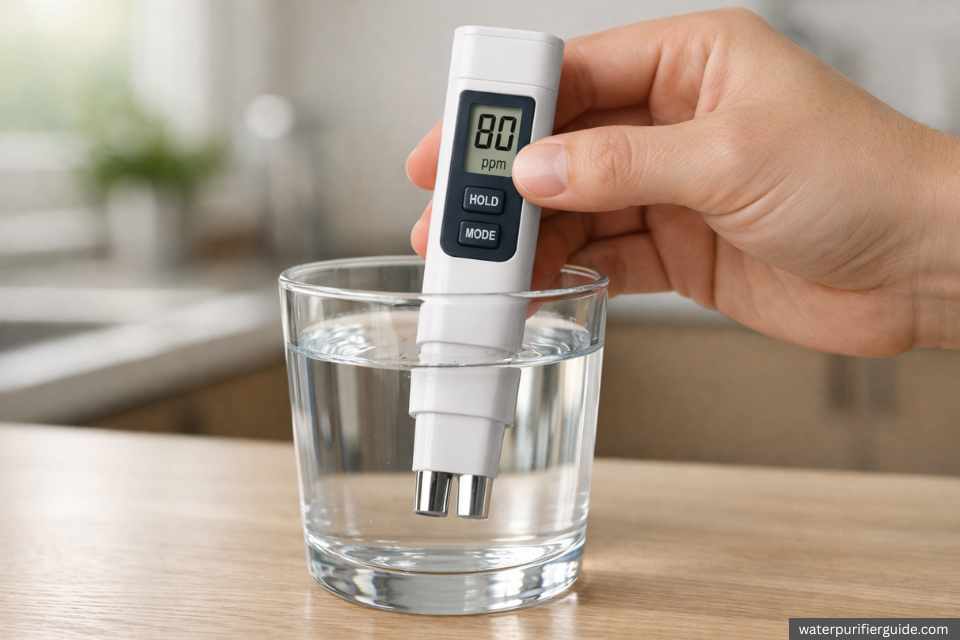
TDS stands for Total Dissolved Solids—that is, the minerals, salts, and other tiny particles dissolved within the water. When you immerse a TDS meter into water, it displays a reading in the form of a numerical value.
This reading helps you understand:
- The quantity of dissolved substances present in the water.
- Whether or not the water is safe for drinking.
- If the water is excessively “heavy” (high in mineral content).
For this very reason, many people nowadays prefer to keep a TDS meter for home use so they can periodically test their water quality.
What Does a TDS Meter Measure in Water?
Now, the question arises: What exactly does a TDS meter measure in water?
Essentially, it measures the total quantity of all dissolved solid substances present in the water.
These substances may include:
- Calcium
- Magnesium
- Sodium
- Iron
- Salts and other minute mineral particles
When all these substances are dissolved in water, their cumulative level is referred to as the TDS level of the water.
The TDS meter displays this level as a numerical value (measured in ppm). Based on this reading, you can understand:
- What the water will taste like
- Whether the water is “light” or “heavy“
- The overall quality of the water
Therefore, if you regularly check the TDS level of your water, you maintain an accurate understanding of your water’s condition.
Why Checking Water Quality at Home Is Important
In today’s times, simply drinking water that looks clean is not enough. If you care about the health of yourself and your family, you must also pay attention to the water quality in your home.
When you check your water using a TDS meter at home, you gain several benefits:
- You can instantly determine whether the water is safe to drink.
- You can understand the reasons behind any changes in the water’s taste.
- You can check the performance of your water purifier.
- You can identify potential water-related issues in a timely manner.
It often happens that the water source changes, or the purifier stops functioning correctly. In such instances, if you continue to perform water TDS tests, you can quickly detect whether there is any underlying problem.
This is why keeping a TDS meter for drinking water in every household is considered a prudent step these days. It allows you to easily monitor the quality of your water without involving any complex procedures.
Important Points to Remember:
- A TDS meter is a simple digital device that helps in assessing water quality.
- It measures the total amount of all substances dissolved in the water (Total Dissolved Solids).
- Based on the TDS reading, you can gauge the taste and overall condition of the water.
- Regularly checking the TDS level at home is a good practice.
- It also allows you to verify whether your water purifier is effectively delivering clean water.
How TDS Meter Works
When you use a TDS meter for the first time, the question inevitably arises in your mind: how exactly does this small device analyze water? The good thing is that its mechanism of operation is not overly complex; rather, it is based on a simple principle.
If you grasp its basic working mechanism, you will be able to understand the water TDS test much more effectively and place greater confidence in its readings.
Basic Working Principle of a TDS Meter
A TDS meter operates on a simple principle known as electrical conductivity.
When substances such as minerals and salts are dissolved in water, they allow electricity to pass through them to a certain extent. This implies that:
The greater the amount of dissolved substances present, The more electricity the water will conduct.
The TDS meter measures this conductivity and converts it into a numerical value (expressed in ppm).
Simply put:
- Low conductivity = Low TDS (Light water)
- High conductivity = High TDS (Heavy water)
With the aid of this principle, you can easily check the TDS level of water right at home and assess the quality of your water supply.
How the Device Measures Dissolved Substances
Now, let’s discuss how the TDS meter actually performs the measurement.
When you immerse the TDS meter into water, the small sensors located inside it become active. These sensors detect the conductivity generated by the dissolved substances present in the water.
During this process:
- The device sends a faint electrical current through the water.
- The dissolved minerals facilitate the passage of this current.
- The meter measures the resulting conductivity.
- And subsequently converts it into a TDS value (ppm).
It is important to note that a TDS meter does not directly measure each individual mineral separately; instead, it provides an estimate of the total dissolved solids present in the water. Therefore, if you regularly use a TDS meter for drinking water, you gain a good understanding of the overall quality of your water.
Understanding the Display and Readings
When you use a TDS meter, a number appears on its screen within just a few seconds. This number represents your water’s TDS reading.
This reading is typically expressed in ppm (parts per million), indicating the quantity of dissolved substances present in the water.
Interpreting the reading is also quite simple:
- Below 50 PPM (Low TDS) → The water may feel “light,” and its taste might seem somewhat bland.
- Between 80-150 PPM (Balanced TDS) → The water tastes normal and is generally more palatable.
- Above 300 PPM (High TDS) → The water may feel “heavy,” or taste salty or bitter.
If you check the TDS level periodically, you can easily determine whether there have been any changes in your water’s quality.
Key Takeaways:
- A TDS meter operates based on the principle of electrical conductivity.
- Dissolved minerals in the water increase its conductivity, thereby providing an estimate of the TDS level.
- The device indirectly measures dissolved substances with the help of sensors.
- The ppm reading displayed on the screen helps in assessing the quality of the water.
- Conducting a water TDS test regularly allows you to monitor the quality of your drinking water.
How to Use a TDS Meter at Home: A Step-by-Step Guide
If you own a TDS meter, using it is not difficult at all. By following a few simple steps, you can easily check the TDS level of your water right at home.
Performing the test correctly is crucial, as even a minor error can result in an inaccurate reading. Therefore, if you wish to conduct an accurate water TDS test, please carefully follow the steps outlined below.
Things You Need Before Testing Water
Before checking the TDS level, you will need a few basic items. The good news is that all of these items can easily be found around your home.
You will need:
- A TDS meter (Digital TDS meter)
- A clean glass or cup
- A water sample (drinking water) to test
- Clean hands and a clean container
Ensure that the glass or container you use to hold the water is thoroughly clean. If there is any pre-existing dirt or residue inside, it could affect the TDS reading.
Step-by-Step Process to Check Water TDS
Now, let’s discuss how to use the TDS meter. This process is very simple and can be completed in just a few seconds.
Follow the steps below:
- First, fill a clean glass with water.
- Now, turn ON the TDS meter.
- Immerse the meter’s probe (the lower section) into the water.
- Be careful not to submerge the meter too deeply.
- Wait for a few seconds until the reading stabilizes.
- Note down the TDS value (in ppm) displayed on the screen.
That’s it! With this simple process, you can easily check the TDS level of your water at home.
If you test water from various sources (such as tap water, tank water, or purified water), you can also easily compare them to determine which water offers better quality.
Common Mistakes to Avoid While Testing
Often, people use a TDS meter but fail to obtain accurate readings due to a few minor errors.
If you want accurate and reliable results, avoid the following mistakes:
- Collecting water in a dirty or previously used container.
- Reusing the meter repeatedly without cleaning it properly.
- Checking the result before the reading has stabilized.
- Submerging the meter too deeply into the water.
- Failing to perform a calibration or battery check each time.
By paying attention to these small details, you can conduct a more accurate water TDS test at home.
If you use your TDS Meter regularly and correctly, you can consistently monitor your water quality and make the right decisions whenever necessary.
What You Should Do Next:
- Always ensure you have a clean container and the proper setup ready before checking TDS levels at home.
- Check the TDS level strictly by following the steps outlined above.
- Avoid minor errors during testing to ensure accurate readings.
- Periodically test water from different sources.
- If you notice a sudden change in the readings, be sure to inspect your water purifier and water source.
Understanding TDS Meter Readings
When you test water using a TDS meter, a number appears on the screen. However, the real question is: what does that number signify, and how should you interpret it?
Simply glancing at the reading is not enough; it is crucial to understand which TDS level is appropriate for your drinking water and when you should exercise caution.
If you correctly interpret the TDS meter reading, you can make better-informed decisions regarding the quality of your water.
What Is a Good TDS Level for Drinking Water?
Maintaining a balanced TDS level is essential for drinking water. Both excessively low and excessively high TDS levels are generally considered undesirable.
Typically:
- 0–50 ppm (Very Low TDS): This water is extremely pure (such as RO-purified or distilled water), but it may lack essential minerals.
- 50–150 ppm (Optimal): This range is considered ideal for drinking water. It offers a pleasant taste and maintains the right balance of essential minerals.
- 150–300 ppm (Good): This water is also considered safe and healthy for consumption. This is the range most commonly found in households.
- 300–500 ppm (Acceptable): This water is still safe to drink, though its taste may feel slightly heavy or distinct.
- Above 500 ppm (High TDS): Water in this range is not considered suitable for long-term consumption. If the TDS level is excessively high (e.g., 1000+ or 1200+), purifying the water becomes essential.
When you test your water with a TDS meter, keeping these ranges in mind allows you to assess the current condition of your water supply.
Low vs. High TDS – What It Means
Now, it is essential to understand what “low TDS” and “high TDS” actually signify.
Low TDS:
- The concentration of dissolved minerals in the water is low.
- The water may taste bland or “flat.”
- This sometimes occurs because the water has been excessively processed (e.g., through Reverse Osmosis).
High TDS:
- The concentration of dissolved substances in the water is high.
- The taste may seem salty, bitter, or “heavy.”
- White deposits (scale) may form on utensils or within pipes.
When you regularly check the TDS level of your water, you can easily determine whether your water falls on the “low” side or the “high” side of the spectrum.
When You Should Be Concerned About Your Water
Not every TDS reading is a cause for concern, but there are certain situations where you should pay close attention.
You should be alert if:
- The TDS level suddenly spikes significantly.
- The taste of the water changes abruptly.
- Your TDS meter consistently displays high readings (500+ ppm).
- The readings from your water purifier appear abnormal.
- Scale deposits begin to form rapidly on utensils or kettles.
In such situations, this could be an indication that:
- The water source has changed.
- The purifier is not functioning correctly.
- Or, the concentration of dissolved substances in the water has increased.
If you conduct water TDS tests periodically, you can quickly identify these changes and take appropriate corrective measures.
Important Takeaways:
- Understanding TDS meter readings is crucial for assessing water quality.
- A TDS level between 150–300 ppm is generally considered ideal for drinking water.
- Very low TDS can result in water that tastes bland, while very high TDS can make the water feel “heavy.”
- Do not ignore sudden or abrupt changes in readings.
- Regularly checking your TDS levels allows you to maintain better control over the quality and condition of your water.
Types of TDS Meters Available in the Market
If you are considering purchasing a TDS meter for your home, you will find a wide variety of options available in the market.
At first glance, all these meters may appear identical; however, their operating mechanisms, accuracy levels, and intended applications can vary significantly.
Therefore, it is essential to understand which type of TDS meter is best suited to your specific needs. By familiarizing yourself with these different types, you can make a more informed and appropriate choice for your home.
1. Digital TDS Meter
The most widely used and popular option is the Digital TDS Meter.
This is a compact, lightweight, and user-friendly device that displays the water’s TDS level within just a few seconds.
Key Features:
- Provides instant and easy TDS readings
- Extremely simple to operate
- Battery-operated, making it highly portable
- Ideal for conducting water TDS tests at home
If you are looking for a TDS meter for home use for your daily needs, the digital meter is considered the most practical and cost-effective option.
2. Portable vs. Professional TDS Meters
When browsing the market, you will typically encounter two main categories of TDS meters: Portable and Professional.
Portable TDS Meter:
- Compact and lightweight in design
- Easily transportable to any location
- Best suited for home use, travel, or daily applications
- Offers a basic level of accuracy
Professional TDS Meter:
- Slightly larger in size and more technologically advanced
- Delivers highly accurate and detailed readings
- Primarily utilized in laboratory or industrial settings
- Generally carries a higher price tag than portable meters
If your primary objective is simply to check the quality of drinking water at home, a portable meter will be more than sufficient.
Which Type Is Best for Home Use?
Now, the question arises: which TDS meter is the best choice for you?
If you are purchasing a meter for household use, there is no need to invest in an overly advanced or expensive device.
For Home Use:
- A digital portable TDS meter is the best option.
- It is easy to use and provides instant results.
- It is perfect for regularly checking TDS levels.
- It is also easily available within a reasonable budget.
Furthermore, if you wish to check the performance of your water purifier, this very meter is sufficient.
Therefore, for most people, a simple digital meter remains a smart and practical choice.
Make an Informed Choice:
- Many types of TDS meters are available in the market, but each serves a different purpose.
- For home use, a digital TDS meter is the easiest and most popular option.
- A portable meter is better suited for daily use, whereas a professional meter is appropriate for laboratory settings.
- Choose a meter that aligns with your specific needs to ensure you obtain accurate readings.
- For regular use, a simple and reliable meter is the most appropriate choice.
Benefits and Limitations of Using a TDS Meter
When you want to understand the quality of the water in your home, a TDS meter proves to be a highly useful tool. However, simply knowing its benefits is not enough—you must also be aware of its limitations.
This helps you understand when a TDS meter provides accurate information and when you need to exercise extra caution.
Advantages of Checking Water with a TDS Meter
If you use a TDS meter regularly, you gain several practical benefits. This is why it is becoming increasingly popular in households everywhere today.
Its key advantages include:
- You can instantly check the TDS level of the water.
- It allows for an easy assessment of the water’s overall quality.
- You can understand the reasons behind changes in the water’s taste.
- You can monitor the performance of your water purifier.
- It makes it possible to conduct a water TDS test right at home.
- You can identify potential water-related issues in a timely manner.
Furthermore, if you test water from various sources (such as tap water, borewell water, or purified water), you can easily compare them to determine which source provides the better quality water.
For this very reason, a TDS meter for home use is considered a simple and sensible investment.
Limitations You Should Know Before Relying on It
Although a TDS meter is highly useful, it cannot measure everything. If you rely solely on the TDS reading, you may sometimes arrive at incorrect conclusions.
Some of its significant limitations include:
- It measures only total dissolved solids; it does not identify individual substances.
- It cannot tell you exactly which specific minerals are present in the water.
- It does not detect harmful substances (such as bacteria or chemicals).
- A low TDS reading does not always guarantee that the water is safe.
- Conversely, a high TDS reading does not always mean the water is harmful.
For instance, water may contain bacteria or germs, but a TDS meter will not be able to detect them.
Similarly, a high TDS reading may simply indicate the presence of certain beneficial minerals. Therefore, if you wish to conduct a comprehensive drinking water safety check, it may sometimes be necessary to resort to other methods (such as a water testing lab).
Final Thoughts to Consider:
- A TDS Meter provides a quick and easy assessment of water quality.
- It is a highly useful and practical device for everyday use.
- However, it cannot detect every type of contamination.
- For better decision-making, use the TDS reading as a basic indicator.
- If you have any doubts regarding the water, conducting additional testing is always a safe measure.
FAQs About TDS Meters:
When you start using a TDS meter, several common questions naturally arise in your mind. These questions are entirely valid, as having the right information is essential for making informed decisions regarding the quality of your drinking water.
Below, you will find simple and clear answers to some of the most common questions, designed to help resolve any confusion you may have.
1. Can a TDS Meter Check Water Safety?
The straightforward answer is: No, not entirely.
A TDS meter only measures the total amount of dissolved substances (Total Dissolved Solids) present in the water. However, it cannot tell you:
- Whether the water contains bacteria or germs
- Whether any harmful chemicals are present
- Whether the water is completely safe to drink
This means that a low TDS reading does not always guarantee that the water is safe.
Nevertheless, checking the TDS level of your water provides you with an estimate of its basic quality, which serves as an excellent starting point.
2. Is a TDS Meter 100% Accurate?
Generally, a TDS meter is quite reliable and accurate, though it is not 100% perfect.
Several factors can influence its accuracy:
- The quality of the device itself
- Whether the calibration is correct
- The condition of the battery
- Whether the testing method used is correct
If you perform a water TDS test at home correctly, you can expect to obtain results that are largely accurate and consistent.
Therefore, it is best to use it as an approximate indicator.
3. How Often Should You Test Your Water?
Many people want to know how frequently they should use a TDS meter to check their water. This depends on your specific needs and your water source, but generally speaking:
- Checking your water once a week is a good practice.
- If you have recently installed a new water purifier, check the water more frequently during the initial period.
- If you notice a change in the taste of the water, check the TDS level immediately.
- It is also beneficial to perform a test during the rainy season or whenever there is a change in the weather.
Regularly checking the TDS level allows you to quickly identify any changes in your water quality.
4. Does Boiling Water Change TDS Levels?
The straightforward answer is: No, boiling does not reduce TDS.
When you boil water:
- Bacteria and germs may be eliminated.
- However, the dissolved minerals and salts remain unchanged.
- In fact, since some water evaporates during the process, the TDS level may occasionally increase slightly.
This means that if you boil water with a high TDS level, its TDS level will not decrease.
For this reason, solutions such as RO water purifiers are typically used to reduce TDS levels, rather than relying solely on boiling.