If you use an RO water purifier, you have undoubtedly heard of the TDS controller. However, many people do not fully understand what it actually does.
Simply put, a TDS Controller in Water Purifier is a small yet crucial component that helps balance the amount of dissolved minerals present in the water.
During the RO purification process, the machine removes dirt, chemicals, and various types of dissolved substances from the water. In this very process, however, beneficial minerals are often removed to a significant extent as well. This is where the TDS controller comes into play.
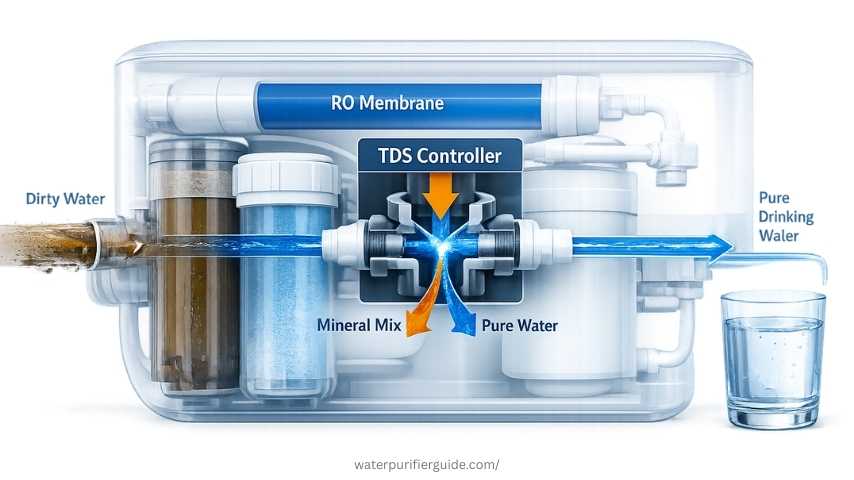
This component blends the highly purified water exiting the RO membrane with a small amount of untreated water (raw water). Through this blending process, certain essential minerals are reintroduced into the water. Consequently, you obtain clean drinking water that not only tastes better but also maintains a balanced mineral composition.
For this reason, many people also refer to it as a TDS adjuster, RO TDS regulator, or water purifier TDS control valve. Its primary objective is not merely to purify the water, but also to ensure it is balanced and suitable for drinking.
Why RO Purifiers Need TDS Adjustment
Now, the question arises: Why is TDS adjustment necessary in an RO purifier?
In reality, RO technology filters water very thoroughly. It is highly effective at removing dissolved salts, heavy metals, chemicals, and impurities. However, this process sometimes purifies the water to an excessive degree—beyond what is necessary.
When the mineral content in the water drops to very low levels, the water may taste somewhat bland or flat. Furthermore, consuming water that contains a balanced amount of minerals is generally considered more beneficial for health.
This is precisely where the TDS Controller in water purifier plays a vital role. By blending the highly purified water from the RO unit with raw water in balanced proportions, it regulates the TDS level in the drinking water. This ensures that the water retains a pleasant taste while preserving its essential mineral content. Furthermore, a TDS controller helps ensure that your purifier does not merely clean dirty water, but also provides you with pure water that is highly suitable for daily consumption.
For this very reason, most modern RO water purifiers today are equipped with a TDS controller or adjuster, in order to maintain—and even enhance—both the quality and taste of the water.
Why TDS Controller is Important for Drinking Water Quality
1. Maintaining Balanced Minerals in Drinking Water
When you purify water using an RO water purifier, the machine removes various impurities—such as dirt, chemicals, and heavy metals—from the water. However, in this very process, the water’s beneficial minerals are often depleted as well.
This is precisely where the TDS Controller in Water Purifier plays a crucial role. It helps maintain a mineral balance by blending a small amount of raw water into the highly purified water produced by the RO system.
Water with balanced minerals is considered superior for drinking. When water contains essential minerals—such as calcium and magnesium—in the right proportions, it not only tastes better but is also more suitable for daily consumption.
For this reason, modern RO water purifier systems are equipped with a TDS controller, ensuring that you receive not just clean water, but balanced drinking water.
2. Improving the Taste of Purified Water
Many people may have noticed that water from certain RO purifiers tastes very light or bland. This occurs because, during the filtration process, almost all dissolved substances are stripped away from the water.
When the mineral content in the water becomes extremely low, its natural taste diminishes as well. Consequently, people often describe RO water as “flat” or tasteless.
To address this issue, the TDS Controller in Water Purifier helps retain a small amount of minerals in the water. This makes the water taste more natural and refreshing.
This is why water from RO purifiers featuring proper TDS adjustment typically tastes better and feels more pleasant to drink.
3. Preventing Water From Becoming Too Pure
Drinking clean water is essential; however, water can sometimes become too pure—purer than necessary. RO technology removes almost all dissolved particles from the water. If absolutely no minerals remain in the water, it is not considered sufficiently balanced for consumption.
To prevent this situation, the TDS Controller in a Water Purifier regulates the water’s TDS level. This ensures that no impurities remain in the water, while also ensuring that essential minerals are not completely eliminated.
In this way, a TDS controller helps your purifier function more effectively. Consequently, you receive pure water that is not only clean but also tastes good and is better balanced for daily consumption.
How TDS Controller Works in an RO Water Purifier
In an RO water purifier, several different filters work together to purify the water. However, when the water becomes excessively pure, it may lose some of its essential minerals. In such instances, the TDS Controller in water purifier helps maintain the water’s balance.
This small component operates within the purifier in a way that ensures the water remains clean while retaining certain essential minerals.
Let’s understand this in simple terms.
Mixing of Purified Water and Normal Water
During the RO purification process, the machine divides the water into two streams:
- The first stream consists of highly purified water that has passed through the RO membrane.
- The second stream consists of a small portion of raw water that still contains certain minerals.
The TDS Controller in water purifier is responsible for blending these two streams of water in a controlled proportion.
When a small amount of mineral-rich water is mixed with the purified water, balanced mineral levels are restored to the drinking water. This not only ensures the water is clean but also improves its taste.
How the TDS Level Is Controlled Inside the System
Inside the TDS controller, there is a small control valve or adjuster. This valve determines the precise ratio in which the purified water and raw water are blended.
If the purified water volume is high and mineral levels are low, the valve introduces a small amount of raw water. This slightly increases the TDS level in the drinking water, thereby bringing the water back into balance.
Conversely, if the water already contains a high concentration of dissolved particles, the system limits the amount of raw water added. In this manner, the TDS control mechanism maintains the overall quality and balance of the water.
For this very reason, a properly calibrated TDS Controller in water purifier provides you with clean drinking water that strikes the perfect balance between purity and mineral content.
Basic Working Process Explained Step-by-Step
To understand this in simple steps, the operation of the TDS controller proceeds as follows:
- First, raw water enters the purifier. Subsequently, the water passes through various filters, and impurities are removed.
- Next, the water flows through an RO membrane, where most of the dissolved particles are eliminated.
- The highly purified water emerging from the RO unit then reaches the TDS controller.
- Here, the controller blends in a small amount of raw water to adjust the TDS balance.
- Ultimately, you receive pure water that is clean, balanced, and pleasant to drink.
In this way, the TDS controller plays a crucial role within an RO purifier. It ensures that the water does not become excessively purified, providing you with balanced and delicious water for your daily consumption.
Main Factors That Affect TDS Control in RO Purifier
In an RO water purifier, TDS control does not depend on a single component alone. In reality, there are several factors that determine the final TDS level of your drinking water.
If these factors are not given proper attention, the water produced by the purifier may end up being either excessively pure (stripped of essential minerals) or, at times, improperly balanced.
Therefore, to ensure that the TDS Controller in water purifier functions correctly, it is essential to understand these key factors.
Quality of Incoming Water
The first and most critical factor is the quality of the raw water entering your home. Water quality varies significantly from one locality to another; in some areas, the water contains a high concentration of dissolved particles, while in others, it is relatively clean.
If the water entering your home is heavily contaminated—classified as “dirty water”—or contains a high concentration of dissolved substances, the RO purifier has to work much harder to purify it. In such a scenario, the TDS controller must also operate differently to maintain the proper balance of the water.
Conversely, if the incoming water is already quite clean, the adjustment required for the TDS controller may differ. Thus, the quality of the water source invariably influences TDS control.
RO Membrane Performance
The RO membrane is the most critical component of an RO purifier. It is the specific filter responsible for removing the majority of impurities and dissolved substances from the water.
If the RO membrane is functioning correctly, it effectively eliminates dirt and unwanted particles. However, over time, dirt and sediment can accumulate on the membrane, or its filtration efficiency may diminish.
When the membrane becomes compromised or worn out, it is unable to filter the water effectively. This directly impacts the TDS level in the purified water. In such situations, the TDS Controller in water purifier may struggle to maintain the correct balance.
For this reason, regular servicing and replacement of the RO membrane are essential to ensure that the water produced by the purifier remains consistently clean and balanced.
Settings of the TDS Control Valve
Inside the TDS controller, there is a small control valve that determines the proportion in which purified water and raw water are blended.
If this valve is not set correctly, the TDS level of the water may end up being either excessively high or too low. Therefore, ensuring the accuracy of the TDS control valve settings is crucial.
In many RO purifiers, a technician adjusts this valve during installation to ensure that the water’s TDS balance remains optimal. In some advanced models, this adjustment is performed automatically.
Thus, the correct TDS Controller setting in a water purifier helps provide you with clean water that tastes good and is well-balanced for daily consumption.
Benefits of Using a TDS Control System in Water Purifiers
The primary function of an RO water purifier is to clean the water. However, simply removing impurities is not enough; the taste and mineral balance of drinking water are equally important.
This is where a TDS Controller in Water Purifier plays a crucial role. It helps maintain a balanced TDS level within the purifier, ensuring that you have access to high-quality drinking water every day. Let’s explore some of its key benefits below.
Better Taste of Drinking Water
When an RO purifier filters water, it often removes a significant portion of dissolved particles and minerals. Consequently, the water can sometimes taste very light or bland.
A TDS Controller in Water Purifier helps enhance the taste by blending a small amount of mineral-rich water back into the purified water. This preserves the water’s natural taste, making it feel fresher and more pleasant to drink.
For this very reason, water from RO purifiers equipped with proper TDS adjustment typically tastes better and offers a more enjoyable drinking experience.
Balanced Mineral Level in Water
The presence of certain natural minerals in drinking water is considered essential. However, during the RO purification process, the levels of these minerals can often become significantly depleted.
The TDS controller helps maintain the mineral balance within the water. It achieves this by blending purified water with raw water in the correct proportions to regulate the TDS level in the drinking water.
As a result, you receive clean drinking water that is free from impurities while ensuring that essential minerals are not completely stripped away.
Improved Drinking Experience for Daily Use
For daily consumption, the taste, quality, and balance of water are of paramount importance. If the water tastes too bland or feels unbalanced, the act of drinking it may not be a particularly satisfying experience.
A TDS Controller in Water Purifier ensures that the water is not only clean but also retains a pleasant taste. When the water’s TDS level is properly regulated, drinking it feels more natural and satisfying.
Thus, the TDS control system transforms your RO purifier from being merely a water-cleaning machine into a device that helps provide you with balanced, delicious, and superior-quality drinking water for your daily needs.
TDS Controller vs Mineral Cartridge in Water Purifiers
Various technologies are employed in RO water purifiers to maintain the quality of the water and balance its mineral content. Among these, two crucial components stand out: the TDS Controller and the Mineral Cartridge.
Many people often mistake these two components for the same thing; however, in reality, they perform distinct functions. If you wish to understand how the TDS Controller in water purifier works and how it differs from a mineral cartridge, examining the distinctions outlined below will prove helpful.
Key Differences Between Both Components
Both the TDS controller and the mineral cartridge aim to enhance the quality of drinking water, but their operational mechanisms differ significantly.
TDS Controller:
- It functions to adjust the TDS level of the water within the RO purifier.
- It maintains the mineral balance by blending a small amount of raw water into the purified water.
- It operates as a control valve system.
- Its primary objective is to prevent the water from becoming excessively purified.
Mineral Cartridge:
- It is utilized to add additional minerals to the water within the purifier.
- It can replenish minerals—such as calcium and magnesium—in the water following the RO purification process.
- It is typically installed during the post-filtration stage.
- Its purpose is to transform the water into mineral-enriched drinking water.
Simply put, the TDS controller balances the minerals in the water, whereas the mineral cartridge serves to add new minerals to it.
Which One Actually Controls Water Minerals?
If the question arises as to which component actually controls the water’s mineral content, the answer lies directly with the TDS Controller in water purifier.
The TDS controller regulates the blend of purified water and raw water. This ensures that the TDS level in water remains balanced—preventing the water from becoming either excessively pure or overly laden with dissolved particles.
Conversely, the mineral cartridge does not directly regulate the TDS level. Its sole function is to add certain beneficial minerals to the water after purification, thereby enhancing both its taste and quality.
Therefore, the role of the TDS controller in regulating the mineral balance within an RO purifier is considered highly significant, whereas the mineral cartridge serves to improve the water’s taste and mineral enrichment.
Common Problems With TDS Controllers in RO Purifiers
The TDS controller is a crucial component within an RO water purifier; however, over time, it may encounter certain common issues. If it fails to function correctly, both the quality and taste of your drinking water can be compromised.
By understanding the common problems associated with the TDS Controller in water purifier, you can identify them early on and implement the appropriate solutions.
Water Taste Suddenly Changes
Occasionally, the water from an RO purifier may suddenly take on a different taste. This is one of the most common indicators that the TDS balance inside the purifier has shifted.
If the TDS Controller is not functioning properly, the ratio of purified water to raw water in the mixture may change. Consequently, the water may taste very light, bland, or—at times—even slightly heavy.
In such a situation, it is advisable to have the purifier serviced or to check its TDS levels to pinpoint the exact cause of the problem.
TDS Level Becomes Too High or Too Low
Another common issue is that the water’s TDS level suddenly becomes either excessively high or excessively low.
- If the TDS level drops too low, the water may taste bland or insipid.
- If the TDS level rises too high, the water may taste heavy or brackish.
This type of problem often arises when the valve of the TDS Controller is not properly adjusted or has developed a malfunction.
Therefore, it is essential to periodically check the water’s TDS level and ensure that the purifier undergoes regular maintenance.
When the Controller Needs Adjustment or Replacement
In many instances, the TDS controller is not completely broken but simply requires adjustment. During the installation or servicing of the purifier, a technician can adjust the TDS controller to restore the proper water balance.
However, if the controller is significantly aged or its valve has become defective, it may become necessary to replace the unit entirely. If you observe that the TDS level in your drinking water is fluctuating frequently, or if the water consistently tastes unusual, it may be an indication that the TDS Controller in water purifier requires adjustment or replacement.
With regular servicing and timely replacements, your RO purifier remains capable of providing clean and balanced drinking water for an extended period.
Does Every RO Water Purifier Have a TDS Controller?
When people consider purchasing an RO water purifier, the question often arises: does every water purifier feature a TDS controller?
The answer is not a simple “yes” or “no,” as it depends on several factors—such as the quality of the water, as well as the purifier’s specific technology and model.
Essentially, a TDS Controller in Water Purifier becomes particularly crucial in situations where the water contains a high concentration of dissolved particles, and where it is necessary to maintain the water’s mineral balance after the RO purification process.
Situations Where It Is Necessary
In certain circumstances, the presence of a TDS Controller in an RO purifier becomes absolutely essential.
- When the water supplied to your home is heavily contaminated or contains a high level of dissolved particles.
- When the water’s TDS level drops excessively following the RO purification process.
- When the water begins to taste very bland or flat.
- When it is necessary to maintain a balance of minerals within the water to ensure the purifier delivers balanced drinking water.
In such situations, the TDS controller regulates the TDS level in water by blending the purified water with a balanced proportion of raw (untreated) water. This ensures that you receive clean water that is superior in both taste and quality.
Types of Water Purifiers That May Not Need It
Not every water purifier requires a TDS controller. There are certain types of purifiers where this component is not necessary.
For example:
- UV water purifiers
- UF water purifiers
- Purifiers used in regions where the water supply is already relatively clean.
These purifiers primarily focus on eliminating bacteria and germs, rather than reducing the TDS level. Consequently, they do not require a TDS control mechanism.
Furthermore, some modern RO purifiers utilize mineral cartridges or automatic mineral enrichment technology, which helps in balancing the mineral content of the water.
Therefore, it is not essential for every RO system to feature a TDS Controller; however, in areas where the water contains a high concentration of dissolved particles, this component proves to be highly effective in delivering pure drinking water of superior quality.
FAQs Section:
Listed below are some common questions regarding TDS Controllers that frequently cross people’s minds. Understanding the answers to these questions can provide you with better insights into your RO purifier and the quality of your drinking water.
1. What is the ideal TDS level for drinking water?
The TDS level for drinking water should be neither too high nor too low. Generally, according to experts, a TDS level of approximately 50–150 ppm is considered balanced for drinking water.
If the water’s TDS level is too high, it may taste heavy or brackish. Conversely, if the TDS level drops too low, the water may taste bland or insipid.
The TDS Controller in Water Purifier helps maintain this balance, ensuring that you have access to clean and balanced water for your daily consumption.
2. Can a TDS controller increase minerals in water?
A TDS controller does not directly add new minerals to the water. Its primary function is to blend purified water with raw (untreated) water in balanced proportions.
When a small amount of mineral-rich raw water is mixed with purified water, the TDS level of the drinking water increases slightly, and the mineral balance is improved.
Therefore, it can be said that a TDS Controller in Water Purifier does not add minerals, but rather helps to balance them.
3. Is a TDS controller necessary for every home?
A TDS controller is not essential for every household. Its necessity depends primarily on the quality of the water supplied to your home.
If the water supplied to your locality contains a high concentration of dissolved solids, and the TDS level drops significantly after RO purification, then a TDS Controller can prove to be beneficial.
However, if the water is already clean, or if you are using a UV UF water purifier, a TDS controller is generally not required.
4. Can I adjust the TDS controller myself?
In principle, the TDS controller in certain RO purifiers can be adjusted manually. However, attempting to adjust it yourself without proper knowledge is not always advisable.
If the adjustment is not performed correctly, the water’s TDS level could become either excessively high or too low. Therefore, it is best to entrust the setting and maintenance of the TDS controller to a trained technician.
Thus, a properly functioning TDS controller in water purifier helps your RO system perform optimally, providing you with clean and balanced drinking water for your daily consumption.